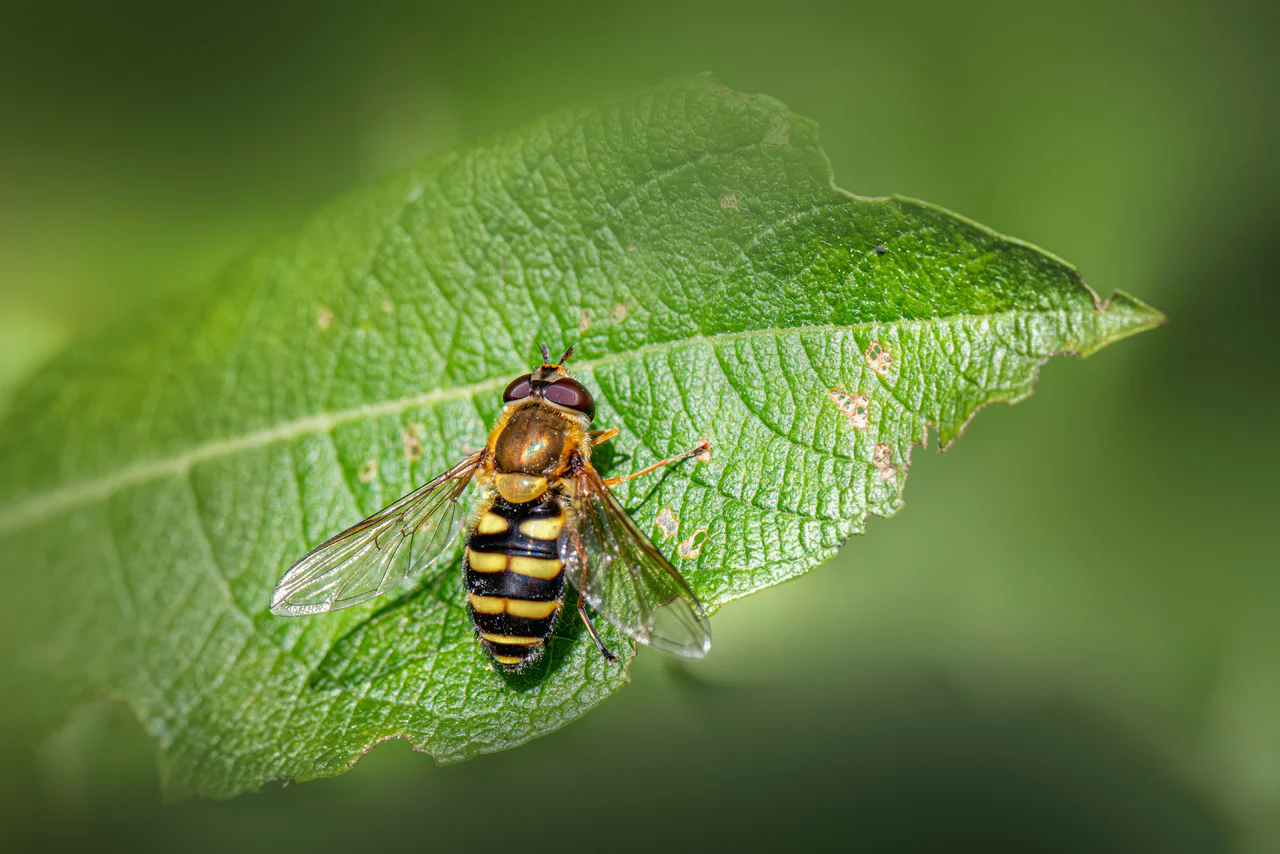
You’re at a picnic table and something yellow and black buzzes past your ear, and your whole body flinches before your brain finishes the sentence “that might just be a fly.” That flinch is the entire strategy. A huge number of the striped, buzzing insects that make people jump aren’t wasps at all, they’re completely harmless flies wearing a costume that’s been tuned by millions of years of near misses.
The quick answer
Adaptive mimicry, specifically the kind called Batesian mimicry, happens when a harmless species evolves to look like a dangerous or foul-tasting one, so predators that have already learned to avoid the real threat avoid the copycat too. The mimic isn’t fooling the predator with intelligence or camouflage in the usual sense. It’s exploiting a lesson the predator already learned the hard way from something else entirely.
How a predator’s bad memory becomes a mimic’s shield
This only works because of how learning actually happens in the animal doing the eating. A young bird that grabs a wasp gets stung once, hard, and afterward it doesn’t carefully verify every future black-and-yellow insect before deciding to avoid it. It generalizes. Anything with that rough pattern gets a wide berth from then on. A hoverfly that happens to carry a similar color arrangement gets protected by a sting it never had to risk delivering, and never could, since hoverflies have no stinger at all.
The model species, the wasp in this case, pays a real cost to maintain that warning signal: it has to actually be dangerous or unpleasant enough that predators learn the lesson in the first place. The mimic pays almost nothing. That asymmetry is why Batesian mimicry keeps re-evolving independently across totally unrelated animal groups, in flies, in snakes, in moths, wherever a genuinely defended species already exists nearby to borrow credibility from.
The textbook example that turned out to be wrong
For most of the twentieth century, biology classes taught a clean example: the viceroy butterfly is a defenseless mimic of the toxic monarch, copying its orange and black pattern to borrow protection it doesn’t actually have. It’s a great story. It’s also not true. In 1991, David Ritland and Lincoln Brower published an experiment in Nature testing birds against viceroy and monarch wings with the bodies swapped, and found birds found viceroys just as distasteful as monarchs. Viceroys have their own chemical defense. This isn’t Batesian mimicry at all, it’s Müllerian mimicry, where two genuinely defended species converge on the same warning pattern so predators only have to learn one lesson instead of two. One of the most cited textbook examples of a mimic borrowing someone else’s protection turned out to be two species sharing real protection between them.
Why imperfect mimics don’t just get weeded out
Here’s the part that puzzled evolutionary biologists for decades. If looking more like the dangerous model always means better protection, natural selection should push every mimic toward near-perfect resemblance. Instead, plenty of mimics are obviously sloppy copies, close enough to fool a human at a glance but clearly off on close inspection. Why hasn’t selection sharpened them further?
A 2025 study in Nature led by Christopher Taylor and colleagues at the University of Nottingham finally tested this directly, using full-color 3D-printed insect replicas ranging from ordinary flies through a spectrum of hoverfly patterns to actual wasps, presented to real predators in the field. Wild birds turned out to be excellent at spotting subtle differences, especially in color and size, and mostly avoided only the genuinely wasp-like models. But when the researchers ran the same replicas past crab spiders and praying mantises, those predators were much worse at telling a rough copy from the real thing. The mimic doesn’t need to fool every predator equally. It needs to be good enough for whichever set of predators is actually hunting it in a given habitat, and since that predator community varies from place to place, so does the pressure to get every detail right.
Two honest limits to how far this protection goes
The trick weakens if the mimic becomes too common. Protection here is frequency-dependent: predators only avoid the pattern because encountering the dangerous version was costly enough to remember. If harmless mimics start vastly outnumbering the real models in an area, predators start getting away with attacking mimics often enough that the warning signal stops paying for itself.
It fails badly when humans are the predator. People don’t learn mimicry lessons through repeated painful trial and error the way birds do, we learn from rules of thumb that don’t always transfer. In the southeastern United States, that shows up as people killing harmless scarlet kingsnakes because their banding resembles the venomous coral snake closely enough to trigger panic, even though the actual order of the color bands, not just their presence, is what separates the two.
What this means the next time something buzzes at you
If a striped insect is hovering in place near flowers rather than darting aggressively and it has short, stubby antennae and only one pair of wings, it’s very likely a hoverfly and not a wasp, and it has no ability to sting you at all. If you’re somewhere coral snakes exist and see a red, yellow, and black banded snake, don’t rely on memory of a childhood rhyme to make the call. Photograph it from a safe distance and identify it properly, since the mimicry here is exactly precise enough to fool an anxious guess.
That flinch at the picnic table isn’t your instincts failing you. It’s a warning signal doing exactly the job it evolved to do, on an insect that never earned the right to trigger it.