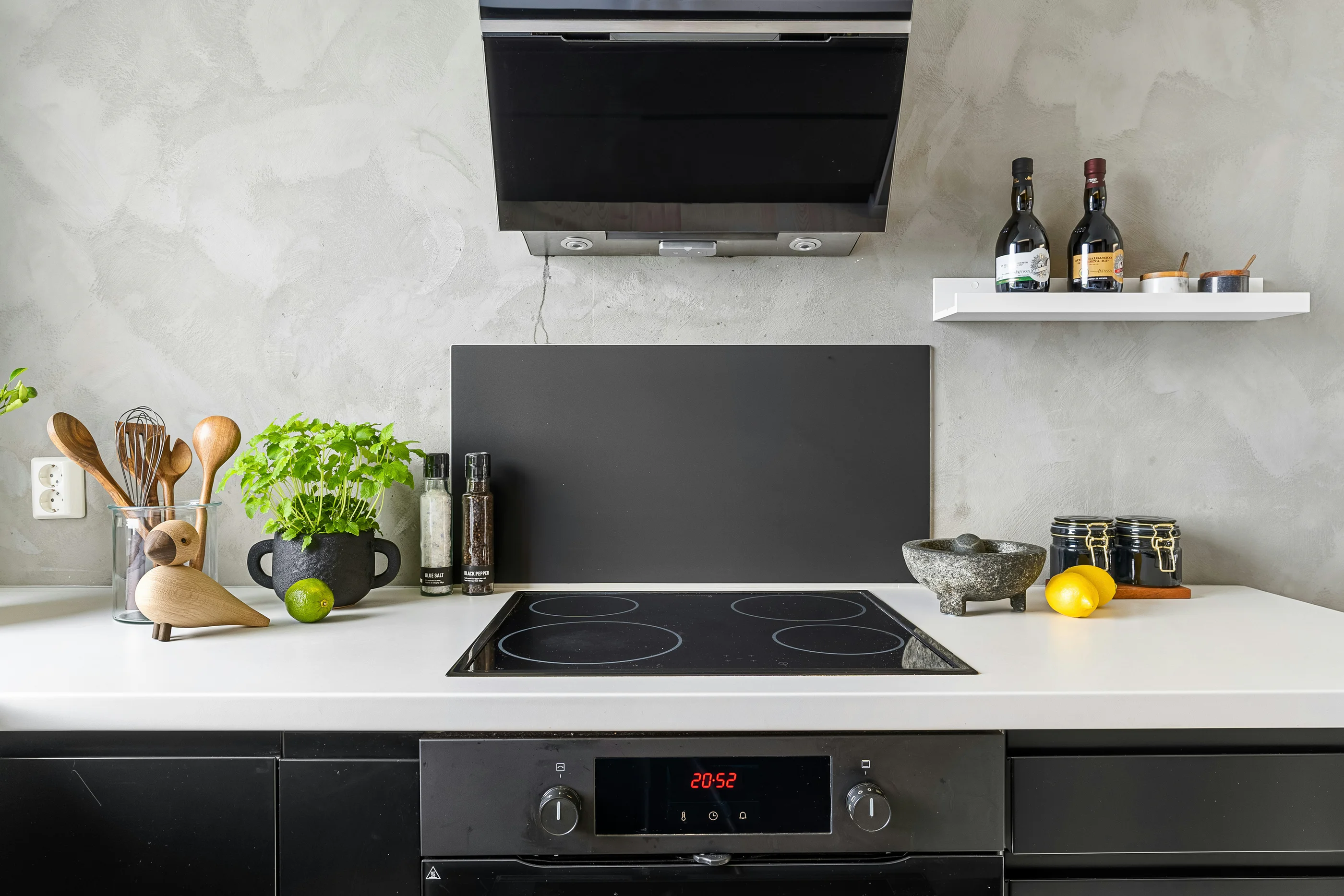
Put your palm flat on the glass an inch from a pot that’s at a full rolling boil on an induction cooktop and it’s just warm, not painful. Move your hand onto the actual pot and you’ll pull it back fast. That’s backwards from every stove you grew up with, where the burner itself is the hot part. On an induction cooktop, the glass was never trying to get hot in the first place.
The quick answer
An induction cooktop doesn’t heat anything directly. A coil under the glass generates a rapidly alternating magnetic field, and when a pan made of the right metal sits on top, that field induces electrical currents inside the pan’s own base. The pan’s resistance to those currents is what makes it hot, so the heat is manufactured inside the metal you’re cooking with, not transferred into it from a burner underneath.
What’s actually happening under the glass
Run alternating current through a coil of wire and you get a magnetic field that reverses direction dozens of thousands of times per second, typically between 20 and 50 kHz in a residential unit. Set a piece of conductive metal inside that field and the constantly flipping magnetism pushes electrons around inside the metal in swirling loops called eddy currents.
Those eddy currents don’t flow freely. The metal has electrical resistance, and pushing current through resistance always generates heat, the same basic principle as a toaster coil, except here the “coil” is the bottom of your saucepan. The ceramic glass between the coil and the pan is a poor thermal conductor and was never part of the circuit to begin with, so it only warms up a little, secondhand, from sitting next to a hot pot.
Why only some pans get hot and others don’t
This is where people usually get tripped up. Sliding a copper or aluminum pan onto an induction burner does almost nothing, even though both metals conduct electricity extremely well. Induction needs the pan to be ferromagnetic, meaning a magnet actually sticks to it, which is why cast iron and most stainless steel work while copper, aluminum, and glass don’t.
The reason ties directly back to that 20 to 50 kHz frequency range. Manufacturers didn’t pick that band arbitrarily. At those frequencies, the eddy currents in a magnetic material like steel get squeezed into an extremely thin layer right at the surface, called the skin effect, shallow enough that it lines up almost perfectly with the thickness of a typical pan’s base. Combine that with steel’s higher electrical resistance compared to copper or aluminum, and steel converts far more of that induced current straight into heat instead of just carrying it along quietly. Copper and aluminum have such low resistance that the same eddy currents barely warm them at all, which is also why hysteresis losses, the other theoretical mechanism for generating heat magnetically, turn out to be almost irrelevant here. Eddy currents in a resistive, magnetic metal are doing essentially all the work.
The efficiency number that actually holds up
The Department of Energy has measured induction cooktops converting roughly 84% of the energy they draw into heat that actually reaches your food, compared to about 74% for a standard smooth-top electric coil and around 40% for gas, where a huge share of the flame’s heat escapes around the sides of the pan into your kitchen air. That 84% figure isn’t marketing copy, it’s the same reason the surface stays cool: almost nothing is being wasted heating the burner itself, so there’s very little leftover heat to radiate outward.
The myth worth putting to rest
A lot of people assume an appliance that runs on “electromagnetic fields” must be emitting something similar to a microwave, and steer clear because of it. It isn’t. Induction cooktops are regulated consumer appliances, and the magnetic field they produce drops off sharply with distance and is designed to stay within the same general safety limits that cover other common household electronics. People with certain implanted medical devices like pacemakers are sometimes advised to keep a bit of distance or check with their device manufacturer, which is a reasonable precaution, but it’s a different conversation from ionizing radiation, and induction cooking doesn’t produce any.
Two honest limitations
Your existing cookware might not work at all. If a refrigerator magnet doesn’t stick firmly to the bottom of a pan, that pan won’t heat on an induction burner, full stop. Anyone switching from gas or standard electric should expect to test their current pots and pans with a magnet before assuming they’re ready to cook.
A full-size built-in unit usually needs a dedicated 240-volt circuit. Most kitchens already have this for an existing electric range, but if you’re converting from gas, budget for an electrician to run a new circuit, which commonly adds a few hundred dollars to the job on top of the cooktop itself, more if your electrical panel needs additional capacity.
What this means depending on your situation
If you’re renting or just want to try induction before committing, a portable single-burner unit plugs into a standard 120-volt outlet and needs no electrical work at all, it’s the cheapest way to find out if your cookware and your habits are compatible. If you’re renovating a kitchen and replacing gas entirely, plan for the cooktop itself plus the cost of a dedicated 240V circuit if one doesn’t already exist, and check your cookware with a magnet before you finalize the budget so you’re not buying a full set of new pots on top of everything else.
That cool glass surface next to a boiling pot isn’t a safety feature bolted on afterward. It’s the direct, physical result of never heating the glass in the first place.